High-Voltage Lithium Battery Packs for Heavy-Duty Commercial and Off-Highway Vehicles
High-voltage lithium battery packs are becoming an important foundation for the electrification of heavy-duty commercial vehicles, off-highway machinery, and specialized industrial equipment.
Compared with low-voltage battery systems, high-voltage platforms can support higher power demand, improved system efficiency, faster charging capability, and better suitability for large-capacity applications. This makes them increasingly relevant for electric construction machinery, mining trucks, port equipment, airport ground support vehicles, industrial vehicles, and other demanding working scenarios.
For heavy-duty electrification projects, battery cooperation is not always limited to a complete pack supply model. Some projects require a mature high-voltage battery pack platform, while system integrators may focus more on industrialized modules, pack-level architecture support, or integration-ready battery subsystems.
LGNE supports flexible cooperation models based on the project boundary, including complete battery pack platforms, industrialized battery modules, and battery system components prepared for further integration by equipment manufacturers and system integrators.
High-Voltage Battery Systems in Heavy-Duty Applications
Heavy-duty commercial and off-highway vehicles usually require much higher energy and power levels than passenger vehicles or light-duty mobility platforms. In many applications, battery systems may range from hundreds of kilowatt-hours to even larger multi-pack configurations.
Typical application areas include:
Electric mining trucks
Electric wheel loaders
Electric excavators
Port and terminal equipment
Airport ground support equipment
Heavy-duty commercial vehicles
Industrial and utility vehicles
Special-purpose electric machinery
In these applications, the battery system must do more than simply meet voltage and capacity targets. It also needs to support continuous high-load operation, vibration resistance, thermal stability, reliable high-voltage distribution, serviceability, and long-term safety.
This is why battery platform maturity becomes especially important in heavy-duty electrification projects.
Why High Voltage Matters
High-voltage battery architectures are commonly used in heavy-duty electric vehicles because they help reduce current under the same power demand. Lower current can reduce electrical losses, improve system efficiency, and make high-power operation more practical.
For large commercial and industrial vehicles, high-voltage lithium battery packs can support:
Higher traction power demand
Faster DC charging capability
Better efficiency under heavy-load operation
Large-capacity battery configurations
More flexible system architecture
Improved compatibility with high-power electric drivetrains
Voltage and capacity, however, are only part of the system discussion. In real vehicle projects, battery integration also depends on mechanical layout, cooling interface, BMS communication, PDU design, safety strategy, and the vehicle’s duty cycle.
Key Application Areas
1. Construction Machinery
Construction machinery such as wheel loaders, excavators, and other off-highway equipment often operates under high load, frequent acceleration, vibration, dust, and wide temperature conditions.
For these machines, the battery system must support:
High energy capacity
High discharge power
Strong structural design
Liquid cooling compatibility
Vibration-resistant pack architecture
Stable BMS and high-voltage protection
Reliable operation under harsh working conditions
High-voltage battery packs are increasingly used as construction equipment manufacturers move from prototype electrification projects toward practical field operation and series production.
2. Mining Trucks and Underground Equipment
Mining applications place very high demands on battery systems. Electric mining trucks and underground vehicles often require large battery capacity, high torque output, and strong environmental adaptability.
Battery electrification can help reduce diesel emissions, improve air quality, lower ventilation requirements in underground mines, and support cleaner industrial operation.
For mining applications, important battery design factors include:
Large energy configuration
High-voltage safety
Thermal management
Mechanical durability
High-current protection
Service and maintenance accessibility
Pack-level reliability under continuous heavy-load operation
These requirements make mining equipment one of the most demanding but also most meaningful application areas for high-voltage lithium battery systems.
3. Port, Terminal, and Airport Ground Support Equipment
Ports, terminals, and airports are also important electrification scenarios. Equipment such as terminal tractors, container handling vehicles, aircraft tow tractors, baggage vehicles, and other ground support equipment often operates in fixed areas with predictable routes.
These operating conditions are suitable for electrification because charging infrastructure can be planned around the working site.
High-voltage lithium battery packs can support:
Frequent start-stop operation
Fast charging between shifts
Lower noise emissions
Reduced fuel logistics
Lower maintenance demand
Compliance with environmental requirements
For these applications, battery system reliability and charging strategy are often more important than maximum driving range alone.
4. Heavy-Duty Commercial and Special Vehicles
High-voltage battery packs are also used in heavy-duty commercial vehicles and special-purpose electric platforms, including electric trucks, municipal vehicles, utility vehicles, emergency service vehicles, and mobile power supply platforms.
Different vehicle types may require different levels of system integration. Some customers need a complete battery pack platform, while others already have their own system architecture and require module-level or pack-level cooperation.
This is why flexible project boundary definition is important. A suitable battery partner should be able to support different cooperation models instead of forcing every project into the same supply format.
What Matters Beyond kWh and Voltage
In heavy-duty electric vehicle projects, battery selection is not only about nominal voltage, capacity, or cell chemistry. A battery platform must also be suitable for real equipment integration.
Key technical factors include:
Thermal Management Interface
Heavy-duty battery systems generate significant heat during high-power discharge and charging. Liquid cooling is often required for large-capacity battery packs.
The battery pack should provide a clear thermal interface so that the vehicle-side cooling system, pump, chiller, heat exchanger, and control strategy can be properly integrated.
BMS and Communication
The Battery Management System plays a central role in monitoring voltage, current, temperature, SOC, SOH, insulation, and fault conditions.
For equipment manufacturers and system integrators, BMS communication and integration logic must match the vehicle control architecture. This is especially important when the customer already has its own system control strategy.
PDU and High-Voltage Protection
The Power Distribution Unit is critical for high-voltage safety and power distribution. Depending on the project boundary, the PDU may be integrated into the battery pack or adapted according to the customer’s vehicle architecture.
Key considerations include contactor control, fuse protection, pre-charge logic, insulation monitoring, emergency shutdown, and service safety.
Mechanical and Vibration Resistance
Off-highway vehicles operate in harsher environments than road vehicles. Battery packs must be designed to withstand vibration, impact, structural load, and long-term mechanical stress.
This requires attention to enclosure strength, module fixation, busbar design, sealing, cooling plate structure, and assembly consistency.
Manufacturing Repeatability and Traceability
For series production, battery performance must be repeatable across batches. This depends not only on the design itself, but also on process control, assembly quality, torque management, EOL testing, and traceability.
Industrialized manufacturing capability is especially important when a project moves from prototype validation to small-series and mass production.
Flexible Cooperation with Equipment Manufacturers and System Integrators
Different customers have different project boundaries.
Some customers prefer to source a complete high-voltage battery pack platform. Others may require customized pack development based on their machine layout, duty cycle, and certification requirements.
At the same time, many system integrators already have strong capability in vehicle-level control, powertrain integration, thermal system design, and final system validation. For these customers, LGNE can support cooperation at the module, pack platform, or battery subsystem level.
Typical cooperation models may include:
Complete high-voltage battery pack supply
Industrialized battery module cooperation
Pack platform adaptation
BMS and PDU integration support
Battery-side thermal interface support
Prototype and pilot build support
Small-series and series production support
This flexible approach allows equipment manufacturers and system integrators to define the right project boundary while using LGNE’s manufacturing, battery platform, and industrialization capabilities.
LGNE Battery Platform Capability
LGNE focuses on lithium battery systems for industrial vehicles, construction machinery, mining equipment, heavy-duty commercial vehicles, and other demanding applications.
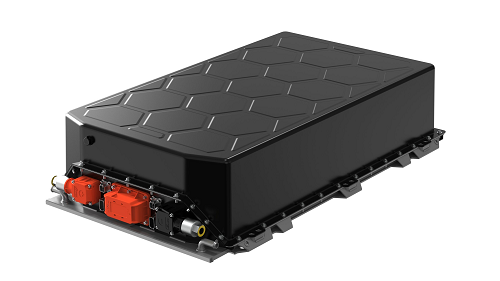
Our battery platform capability covers high-voltage LFP battery systems, industrialized battery modules, and pack-level solutions for different vehicle architectures.
LGNE’s high-voltage battery platforms can support applications requiring:
400V to 800V-class battery architectures
Large-capacity battery configurations
LFP chemistry
Liquid cooling design
BMS and PDU integration
High-voltage safety protection
Mechanical robustness for off-highway environments
Production traceability
Custom configuration based on project requirements
With experience in heavy-duty electrification scenarios, LGNE supports customers from early technical evaluation to prototype development, pilot build, and series production preparation.
Conclusion
High-voltage lithium battery packs are playing an increasingly important role in heavy-duty commercial vehicles and off-highway electrification.
For construction machinery, mining trucks, port equipment, airport ground support vehicles, and special industrial platforms, battery systems must provide not only sufficient voltage and capacity, but also reliable integration, thermal stability, mechanical strength, safety protection, and manufacturing repeatability.
LGNE supports equipment manufacturers and system integrators with flexible battery cooperation models, including complete pack platforms, industrialized modules, and integration-ready battery system solutions.
By combining high-voltage battery platform experience with industrialized manufacturing capability, LGNE aims to support the transition from prototype electrification projects to reliable real-world equipment applications.